Every autumn, Sprudge does the same accounting exercise: it takes the year’s Build-Outs of Coffee — the new cafés it profiled from spring to fall — and reads them like tea leaves. The 2026 edition ran from May into October, 44 cafés across nine countries, and the headline finding is the kind that starts arguments in group chats: is pour over dying?
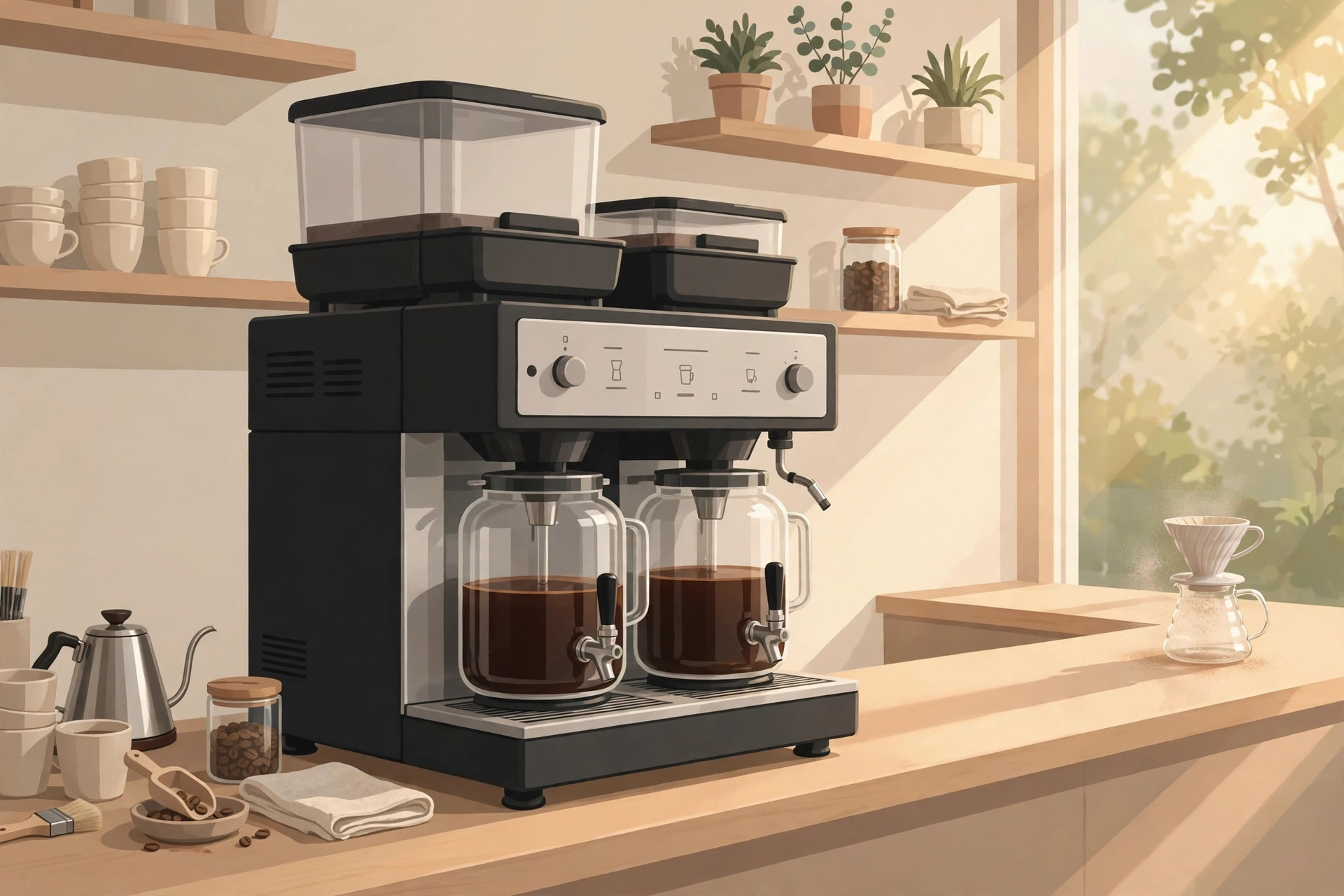
Not dying in your kitchen. Dying on the menu board. Of the 44 new cafés, only 23 even mentioned their brewed-coffee setup at all. Of those 23, fifteen listed an automated or batch brewer as their only filter option. Just six mentioned pour-over devices alone. The pour-over bar — the slow, theatrical centrepiece that defined specialty coffee for a decade — has quietly become an afterthought in the shops opening right now.
That is a real shift, and it is worth understanding before you decide what it means for the way you brew at your desk.
/ 01The numbers behind the headline
The 2026 Build-Outs crop is not a random sample of coffee shops. These are the ambitious ones, the openings Sprudge chose to feature, from Los Angeles and the Bay Area to New York, Atlanta, and Dallas, plus cafés across Central and North America, Europe, the Middle East, and South and Southeast Asia. What they chose to build tells you where the confident money in coffee is going.
First, this was a year of established names expanding. 68% of the cafés were second locations, many from the biggest names in the industry: Onyx Coffee Lab, Madcap, Phil & Sebastian, Partners, Variety, Workshop, Sightglass, Ritual, Stumptown. Last year first-timers ruled; this year the veterans opened the new rooms.
Second, the roaster-café is now the default. 78% of the 44 cafés roast their own coffee, and that figure held for first-timers and established brands alike. Multi-roaster cafés — the shops that used to stock beans from nine different roasters and let you taste your way across the map — made up only 14%. That matters for pour-over, because the multi-roaster café was the format that carried the pour-over torch. A shop with one roaster’s beans and one brew method has less reason to keep a row of drippers on the bar.
Third, the equipment lists read like a consolidation. La Marzocco machines — the whole family of brands — made up two out of every three espresso machines named. The Linea, for the first time ever, was not alone at the top: it tied with the Modbar at eight installations each, with Slayer next at five. On grinders, Mahlkönig still took exactly half of all grinders named, but the EK43 — the grinder that used to win this count walking away — was in a four-way tie at six apiece, sharing the top with Mahlkönig’s own E65 and E80 and, notably, the Weber EG-1, the first non-Mahlkönig grinder ever to top the list.
None of that is a eulogy. It is a picture of an industry that has picked its winners and is now building around them.
/ 02Why batch brewers ate pour-over’s lunch
Sprudge’s Zac Cadwalader, who wrote the analysis, puts it bluntly: lattes keep the lights on, and pour-over is mostly an afterthought. That is not a new complaint — milk drinks have paid the rent for years — but the 2026 numbers show the gap widening into a structural choice.
A batch brewer makes sense for a café in ways a pour-over bar never did. One machine brews a litre and a half at a time, holds it at temperature, and serves a queue in seconds. A pour-over takes three to four minutes per cup, one cup at a time, and needs a trained barista standing over it the whole time. When your rent is set by a second location in Brooklyn or Bentonville and your morning rush is a line out the door, the maths is not close.
There is a second, quieter reason. The new cafés are roaster-cafés, and a roaster-café sells a point of view: our beans, our roast, our recipe. A batch brewer delivers that point of view consistently, cup after cup, without depending on which barista is on shift. Pour-over, done well, is a performance of skill; done averagely, it is a slower, more expensive cup that tastes about the same as the batch. Shops are choosing the reliable version.
Cadwalader’s own reading is more pointed than that. He argues cafés are leaning into what sells rather than what they want to serve, and that something is getting lost: “the wild expressions of coffee and service in favor of the middle of the road.” He is not demanding every café return to a 2010s-era wall of nine roasters and a forest of drippers. His point is that there is room for both — the latte pays the bills so the shop can also serve coffee the way it believes in.
/ 03What this means at your desk
Here is where the café trend collides with the home setup, and where the headline needs a correction. Pour-over is not dying. Pour-over as a café’s marketing hook is dying. Those are different things, and the difference is good news if you brew at your desk.
The batch brewer’s advantages — speed, consistency, volume — are café advantages. At a desk, you are brewing one cup for one person, and the trade-offs invert. A V60 costs a fraction of a batch brewer, takes up less space than a monitor stand, and gives you something no café batch brewer can: control over a single origin’s extraction, cup by cup. The reason pour-over mattered in the first place was never throughput. It was clarity — the way a washed Ethiopian or a pink bourbon from Panama opens up when the water moves slowly through the bed.
So the honest takeaway is not “buy a batch brewer.” It is that the café and the desk are diverging, and you should stop copying café menus when you design your setup. The cafés are optimising for the queue. You should optimise for the one cup you actually drink between standup and lunch.
That said, the trend carries a warning for home brewers too. The same logic pushing cafés toward automation is pushing home gear the same way: automated pour-over machines, app-controlled brewers, machines that read a roast’s parameters off a chip and set grind, temperature, and flow rate for you. The convenience is real, and for a busy morning it is genuinely hard to argue with. But every automated step is a step away from understanding why your coffee tastes the way it does. If you can already brew a good V60 by hand, an automated machine is a luxury. If you cannot, it is a shortcut that will keep you from ever learning — and the day it breaks, or the day you taste a coffee it cannot handle, you will have no fallback.
/ 04The counterargument, stated fairly
Before the pour-over loyalists sharpen their knives: the data has limits, and Cadwalader says so himself. A café not mentioning its brewed setup in a Build-Outs profile does not mean it has no filter coffee. Pour-over may still be on the menu, just no longer noteworthy enough to list. Forty-four cafés is a real sample, but it is a sample of ambitious new openings, not of the whole industry. And the multi-roaster café is not extinct — 14% of the crop still runs that model, and those shops are exactly where the most interesting filter coffee lives.
There is also the social evidence. Pour-over is all over Instagram and Threads right now — close-up brewing reels, new origins, automated pour-over machines drawing crowds in comments. The method has a lively home-brew culture even as cafés deprioritise it. A brewing method can lose the café and keep the kitchen. French press did exactly that decades ago.
/ 05The bottom line
So, is pour over dying? In the cafés opening in 2026, yes, more or less — as a featured offering, as a selling point, as the thing a new shop builds its identity around. Six out of 44 cafés leading with pour-over alone is not a rounding error. It is a verdict on what sells.
But the verdict is about cafés, not about coffee. The same year cafés walked away from the dripper, home brewers kept posting pour-over reels, roasters kept releasing single origins that only make sense brewed slowly, and the grinders at the top of the café charts — the EK43, the EG-1 — are grinders built for filter clarity as much as espresso. The tooling for great pour-over has never been better. It is just no longer the café’s job to show it off.
That leaves the job to you. Keep the dripper on your desk. Learn the method properly, because nobody at the café downstairs is going to teach you any more. And when the next café trend piece declares something dead, check the numbers first — then check whether the numbers describe your kitchen at all.
---
HexRoast is a coffee journal. No product is for sale and no preorder is open. Contact: hello@hexroast.com.
Questions about this article: hello@hexroast.com — the one contact address for this site. HexRoast is currently a coffee journal; no product is for sale and no preorder is open.
/ 06Sources
- Sprudge, “The Analytics of Autumn: Trends and Surprises From the 2026 Build Outs of Coffee” by Zac Cadwalader, published November 10, 2026 — https://sprudge.com/the-analytics-of-autumn-trends-and-surprises-from-the-2026-build-outs-of-coffee-1457338.html
- Social search (Instagram / Facebook / Threads, posts from 2026-11-08 to 2026-11-10) — pour-over brewing reels and an automated pour-over machine video confirm the method is actively discussed at home-brewer level right now; no contradiction with the café-trend data.
- Note: No affiliate links, no purchase links, and no brand-launch claims are included in this article.
More coffee writing in this section — no signup, no preorder, just the journal.
More in Culture →