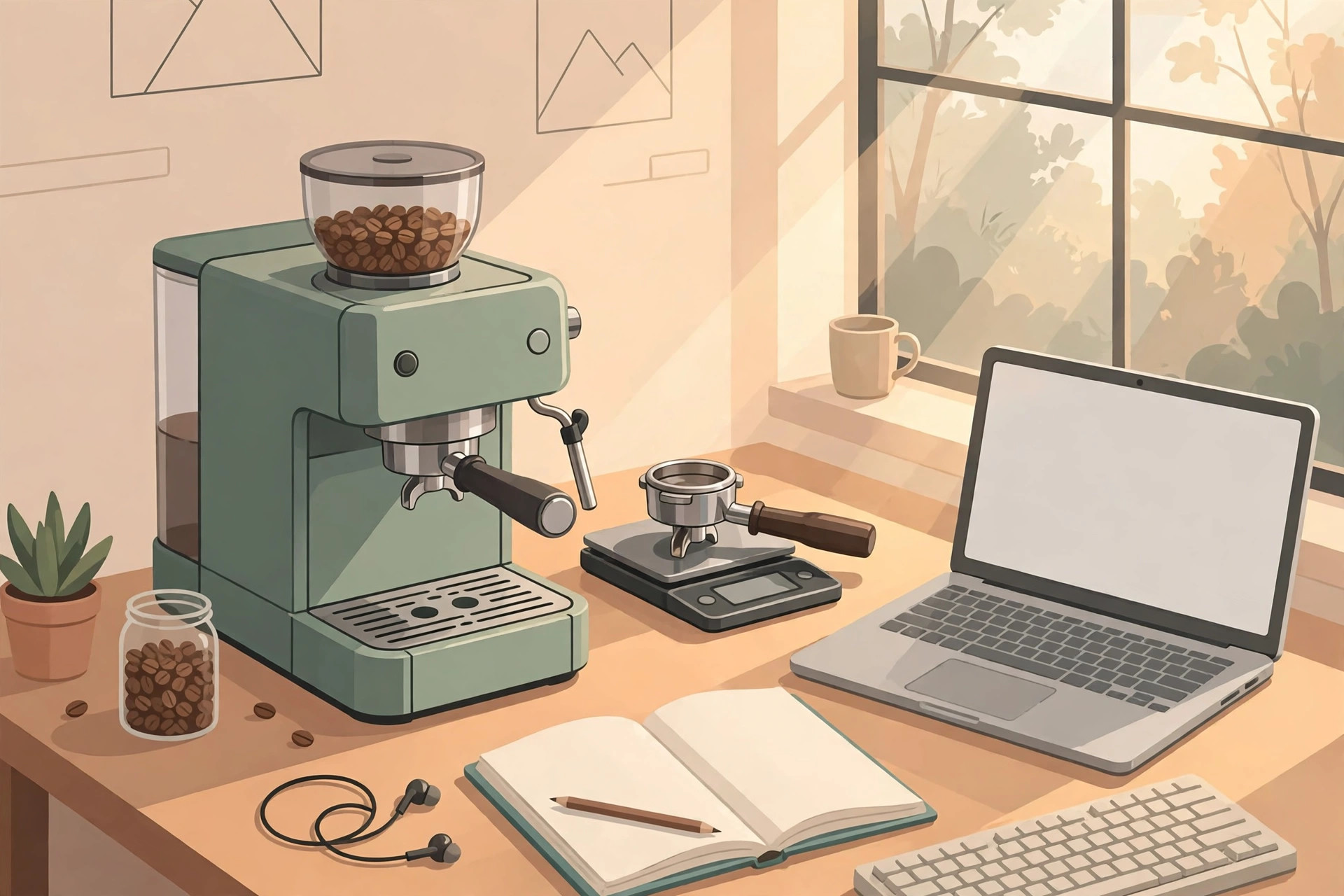
Ask any home barista which machine taught them espresso and one name comes up more than any other: the Barista Express. Sage sells it as the Barista Express in the UK and Europe, Breville sells the same machine in the US and Australia, and for years it has been the default first serious machine — grinder built in, a real 54 mm portafilter, a manual steam wand, and a price that sits just under the point where most people stop and think twice. It is the machine a huge share of the home-espresso internet learned on, including plenty of developers who bought one the week they decided their desk setup deserved better than a pod.
In November 2026 Sage launched its successor, the Barista Express Neo. It is not a redesign. It is the same idea with help added exactly where beginners lose the most shots: getting the dose right and knowing whether to grind finer or coarser. The UK and European launch is expected on 17 November 2026, priced at £779.95 in the UK and €879.95 in Europe. US pricing had not been confirmed at the time of writing, so anyone stateside should treat the European figures as a guide to the tier, not a dollar price. Prices here are reference prices — they move, and November is the month they move fastest.
/ 01What actually changed
The Neo keeps the bones of the original: conical burr grinder built into the machine, 54 mm stainless steel portafilter, 2-litre water tank, and you still tamp, pull the shot, and steam the milk yourself. The differences are four features, and each one answers a specific frustration that shows up in every home-espresso forum within a month of someone buying the original.
The headline change is Acaia Grind by Weight. The grinder weighs the coffee as it grinds, so every shot starts with the same dose. That sounds minor until you have spent a month chasing a sour shot and realised you changed two variables at once — the grind and the dose — and now have no idea which one fixed it or broke it. Dosing by weight is the single most repeated piece of advice given to new home baristas, and it is also the step most people skip, because it means putting a scale under the portafilter and doing arithmetic before coffee. The Neo removes the chore. On the original you set the grind amount by hand and check it with a scale if you are disciplined enough to bother. Most people are not, at 7 a.m.
The second change is Smooth Shot with Auto Flow Control. When a shot runs too fast, the machine slows the flow to keep the extraction between 25 and 35 seconds. It does not replace a good grind setting, and nobody should buy this machine thinking it will rescue a grind that is wildly wrong. What it does is save the marginal shot — the one that would have run in 18 seconds and tasted thin and sour — by pulling it back into a drinkable range. For someone still learning how a new bag behaves, that is the difference between a wasted morning and a decent flat white.
Third is Grind Size Guidance. After every shot the display tells you whether to grind finer or coarser. This is the step where beginners stall hardest, especially with a fresh bag. Light roasts and single origins, the coffees specialty drinkers actually want to brew, are the ones where the original’s 16 grind settings start to feel coarse, and where a new drinker has no feel yet for what “too fast” means. The Neo doubles the range to 30 settings, which matters most exactly there, with lighter roasts that need finer adjustment to extract properly.
Fourth, and the easiest to overlook, the Neo is the first machine in the Barista Series to make cold brew and iced drinks, in under three minutes according to Sage. That is not traditional overnight cold brew, and it would be dishonest to present it as such — it is a fast iced-coffee function, a convenience for people who want a cold drink without planning twelve hours ahead. The steam wand is now a Cool Touch wand, insulated so the outside stays cooler and milk residue wipes off more easily, though you still texture the milk yourself with the same control over microfoam.
/ 02The price picture, honestly stated
This is where the launch lands squarely in the question every home-espresso buyer actually asks: how much machine do you get at five hundred, and what does the next step up buy you?
The original Barista Express lists at $699.95 in the US, and in November 2026 it is on a manufacturer promotion at $499.95 across all three finishes — brushed stainless steel, black sesame, and black truffle — with the rebate behind that price reported as ending 9 November. In the UK, Sage lists the original bundled with a thermal milk jug at £499.95, down from £629.95. Those are reference prices that change, and the November sale window is short, but the direction is clear: the original is currently the $500-tier machine, and it is a lot of machine for that money.
The Neo, at £779.95 and €879.95, sits a clear step above — in the band below $1,000 that has always been the awkward middle of home espresso. It is not competing with the $2,000-plus dual-boiler machines, and it is not trying to. It is competing with its own predecessor, and with the question of whether a beginner should pay roughly 50% more for the machine to take over dosing and give feedback on grind size.
That framing matters because the honest answer depends on who is buying. If you enjoy the learning curve — if you already own a scale, you like the ritual of dialling in, and the trial and error is part of the pleasure — the original at its current sale price is hard to argue against. It does the job, it has done the job for years, and the money you save buys a lot of good beans. If you want a good shot in the first week, if you drink light roasts and single origins, or if you know yourself well enough to admit the scale will live in a drawer by February, the Neo is aimed directly at you.
There is a third option worth naming, because the Neo does not cover it: if tamping is the step you want help with, the Barista Express Impress is still the machine that tamps for you. The Neo leaves tamping manual. Sage has now split the beginner’s problems across three machines — the original for the patient learner, the Neo for the person who wants dose and grind help, the Impress for the person who wants dose and tamp help — and the right choice depends on which part of the workflow you actually find tedious, not on which box looks newest.
/ 03What it does not do
A launch-week article that only lists new features is doing the reader a disservice, so here is the other side. The Neo does not auto-tamp. It does not steam milk for you. It is still a 54 mm system, so the large ecosystem of 58 mm accessories does not fit it. The cold brew function is a shortcut, not a replacement for a proper overnight steep. And at the time of writing there are no independent long-term reviews — the machine launches on 17 November in the UK and Europe, and the early coverage is hands-on previews and Sage’s own press release, not months of ownership. Anyone promising a verdict on reliability or shot quality after a week with a launch unit is guessing. The sensible read of the Neo is as a set of well-aimed fixes to a proven machine, not as a revolution.
That restraint is also what makes it a good fit for a desk setup, which is the part HexRoast actually cares about. The original Barista Express earned its place on developers’ desks because it is one machine instead of three — grinder, espresso maker, and steamer in a single footprint — and because its workflow rewards the same habit that makes a good build pipeline: change one variable at a time and write down what happened. Grind by weight is that habit built into the hardware. It is the coffee equivalent of pinning a dependency version instead of letting it float and wondering why the build broke on Tuesday.
/ 04The bottom line
The Barista Express Neo is a modest, well-targeted update to the most recommended starter espresso machine there is. It fixes dosing, it gives feedback on grind size, it adds a little more room for light roasts, and it throws in fast iced drinks for good measure. It costs meaningfully more than the original, which is currently discounted to the $500 tier in the US and £499.95 bundled in the UK, and its US price is still to be confirmed. For a first-time buyer who wants the machine to carry the hardest parts of the learning curve, it is the more sensible buy. For a buyer who enjoys the curve, the original on sale is the better deal, and the money saved is better spent on beans.
Either way, the interesting thing about this launch is not the machine itself. It is what it says about where home espresso is going: the manufacturers have finally accepted that the barrier is not the hardware, it is the knowledge in the user’s head. The next generation of home machines will not just brew better. They will teach, dose by dose, shot by shot, until the beginner stops needing them to. The Neo is an early, imperfect step in that direction — and for the person standing in front of it at 7 a.m. with a new bag of single origin and no idea whether to grind finer, that step is worth real money.
---
HexRoast is a coffee journal. No product is for sale and no preorder is open. Prices above are reference prices as listed on November 11, 2026, and change — re-check before repeating them. Contact: hello@hexroast.com.
Questions about this article: hello@hexroast.com — the one contact address for this site. HexRoast is currently a coffee journal; no product is for sale and no preorder is open.
/ 05Sources
- OR Coffee Roasters, “Sage Barista Express vs Barista Express Neo” (published 2026-11-09; features sourced from Sage Appliances press release, November 2026) — https://www.orcoffee.info/blogs/blog/sage-barista-express-vs-barista-express-neo
- The Gadgeteer, “Breville Barista Express espresso machine drops to $499.95 in November 2026” (published 2026-11-08, updated 2026-11-10) — https://the-gadgeteer.com/2026/11/08/breville-barista-express-espresso-machine-drops-to-499-95-in-november-2026/
- CoffeeBlog / YouTube, “The New Barista Express Neo” — UK £779.95, EU €879.95, US pricing TBC, expected UK/EU launch 17 November 2026 — https://www.youtube.com/watch?v=NAxn9wd4p2M
- Note: No affiliate links, no purchase links, and no brand-launch claims are included in this article.
More coffee writing in this section — no signup, no preorder, just the journal.
More in Build →