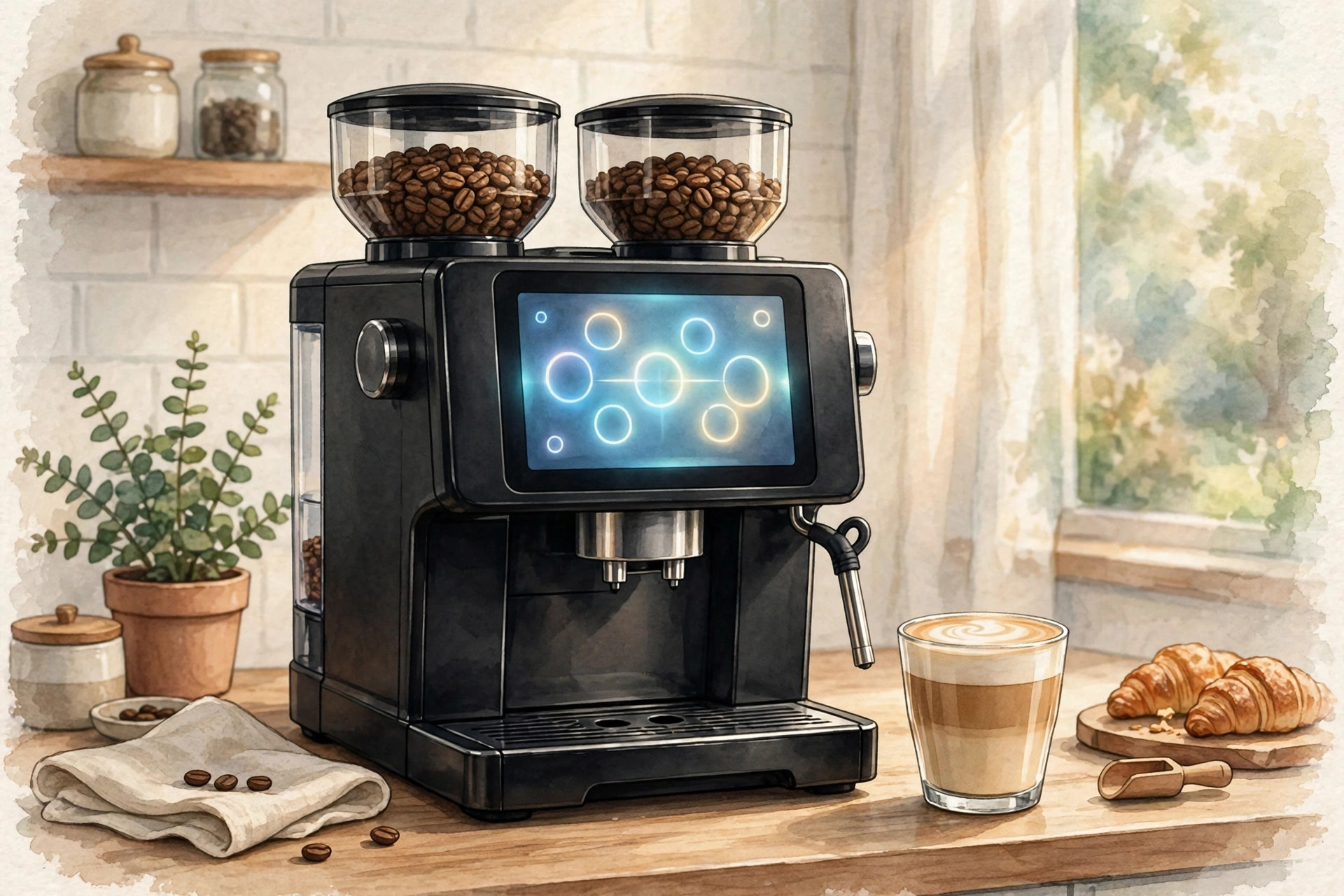
The Ninja AutoBarista Pro launched in May 2026, and for five months almost nobody in specialty coffee talked about it. November changed that. TechCrunch published a hands-on review on 8 November, a detailed spec breakdown followed on 11 November, unboxing reels started appearing on Instagram and Facebook the same week, and search data for November lists “Ninja Auto Barista Pro” at 33,100 monthly searches — a term that barely existed a year ago. The machine is also showing up in Christmas gift guides as a just-landed Amazon pick. So the timing of this piece is not the launch. It is the moment the reviews landed, the search volume spiked, and the question stopped being “what is it” and became “should I buy one.”
The short answer is that the Ninja AutoBarista Pro is the most honest test yet of a question home espresso keeps dodging: how much of the ritual do you actually want? This machine’s answer is none of it. It grinds, doses, tamps and brews from a single press of the screen. You pick a drink, it hands you the drink. Whether that is a bargain or a betrayal depends entirely on what you think the morning cup is for.
/ 01The Ninja AutoBarista Pro in full: what $949.99 buys
The Pro is the AE1051, the top version of Ninja’s first fully automatic espresso machine. The standard AutoBarista, the AE1001, costs $899.99. The Pro costs $50 more, and the difference is concrete: two swappable 340-gram bean hoppers instead of one 250-gram hopper, thirteen drink programs instead of ten, an extra-thick froth setting, and an 80-ounce water tank instead of 70. The three extra drinks are lungo, cortado and iced latte. The stainless steel finish is the $949.99 one; the Golden Pine finish costs $999.99. Amazon’s listing currently sits at $999.95, so Ninja’s own store is the cheaper place at the time of writing. All prices here are reference prices — they move, and November is the month they move fastest.
The full drink list covers the order board most people actually use: espresso, lungo, cortado, flat white, latte, cappuccino, Americano, drip coffee, cold-pressed coffee, cold brew and iced latte. Milk is handled by a system Ninja calls FrothPerfect, with five textures from plain steamed milk through thin, thick and extra thick to cold foam, plus a setting for plant-based milk. The machine reads bean size, roast type and freshness through a feature called Grind iQ, then picks a grind size and dose from 50 settings and weighs each dose as it goes. Underneath that is a 15-bar pump tuned to deliver 9 bars at the puck, a 1,650-watt boiler, and a touchscreen where brew strength, temperature, size and froth style can each be adjusted per drink, with favourites saved for next time.
That spec sheet is doing a specific job. The AutoBarista is not one machine pretending to be a café. It is five appliances — drip brewer, espresso machine, grinder, milk frother and scale — folded into a single box, and the pitch is that a household where one person drinks flat whites, another drinks drip, and a third wants iced lattes in July can stop negotiating over counter space. Two hoppers make that pitch real in a way a single hopper cannot: a bright single origin in one, a chocolatey decaf in the other, and after-dinner coffee stops being a compromise.
/ 02What November’s reviews actually say
The most-read review so far is TechCrunch’s, published 8 November by Amanda Silberling, who spent weeks making about a dozen different drinks with the machine. Her verdict is the useful kind: she says it makes good drinks, and she is explicit that she is not invested in the brewing process — she has never analysed an espresso puck and does not want to start. For her, the machine delivers exactly what it promises. Then comes the part that made the review travel. The AutoBarista rinses itself before and after every drink, which is good hygiene and also means the drip tray fills after just a few drinks. Silberling emptied it daily, overfilled it more than once, and spilled coffee-tinted water on her kitchen floor. That, she writes, is the dealbreaker. She also warns about the knock box that collects spent pucks: forget it for a few days and the next thing you find is blue mould. She is candid that this is partly a portrait of her own habits — she makes one big batch of cold brew every other week and wants her morning ritual minimal — but the drip tray complaint is structural, not personal. A machine that rinses itself twice per drink will always produce that water, and someone has to empty it.
The second thing worth knowing is that the reviewers do not agree with each other about the espresso. Coffee Lab Advisor, which synthesised eleven independent hands-on reviews of the Pro, reports that they disagree sharply on the espresso while agreeing on almost everything else — the convenience, the drink range, the frothing. That split is information in itself. A machine this automated produces a consistent cup, but “consistent” and “excellent” are different claims, and five months after launch there is no consensus on which side of that line the AutoBarista sits. There is also no long-term reliability record yet. The warranty is one year, and anyone promising a verdict on durability after a few weeks with a review unit is guessing.
The social side of the story confirms the audience. The reels appearing this week are not barista tutorials. They are unboxings, a salon owner setting one up for clients, a holiday-season kitchen video with the machine making iced lattes in a travel tumbler. The comments are purchase questions, not technique questions. That is the market Ninja is actually selling to, and it is a large one.
/ 03The question this machine forces
Here is where the Ninja AutoBarista Pro gets interesting for HexRoast readers specifically, because it is the opposite philosophy to the machine we covered three days ago. The Sage Barista Express Neo, launched this month, adds grind-by-weight dosing and flow control to a machine where you still tamp, pull the shot and steam the milk yourself. It teaches. The Ninja removes the lesson entirely. There is nothing to learn, which means there is also nothing to get better at. That is not a flaw in the machine. It is the product. But it is worth saying plainly, because the two machines cost nearly the same money — the Neo sits around £779.95 in the UK and €879.95 in Europe, the Ninja at $949.99 in the US — and they are selling opposite ideas about what a morning is for.
The developer analogy writes itself, and it is worth resisting the easy version of it. The easy version says the Ninja is the no-code tool and the manual machine is the hand-rolled framework, and one of them is for serious people. The honest version is about maintenance. A fully automatic machine is a dependency you do not control: when the grinder calibration drifts, when the brew group needs descaling, when the milk system clogs, you are inside Ninja’s service world, with a one-year warranty and a 39.44-pound box that does not travel to a repair shop casually. A manual setup is more work every morning and less work the day something breaks, because every part is visible and replaceable. Developers know this trade-off from every tool they have ever adopted. The question is not which is better. It is which failure mode you would rather live with.
There is also a physical question the spec sheet answers bluntly. The AutoBarista Pro is 17.81 by 10.68 inches and 15.82 inches tall, and it weighs 39.44 pounds. That is up near where upper cabinets start on a lot of counters, and once it lands, it stays. Measure first. A desk setup has even less room to be wrong about this than a kitchen does.
/ 04The $1,000-tier question, answered honestly
The AutoBarista Pro sits squarely in the $1,000 tier of home espresso, and that tier has always been the awkward middle. Below it, the original Barista Express is currently on sale in the US at $499.95, and it asks you to learn. Above it, super-automatics from Jura and others cost considerably more and do the same job with a coffee-brand badge. The Ninja’s case for the money is breadth: no $950 machine from a coffee brand makes drip coffee, cold brew and thirteen espresso drinks from one box with two bean hoppers. Its case against the money is that breadth is the whole case. If you only drink flat whites, you are paying for twelve drinks you will never press, and a simpler machine plus a good grinder would make a better flat white for less.
That is also why the Christmas framing matters and should be handled with care. This is the machine gift guides will push in November because it photographs well, has a clear price, and needs no skill to demonstrate. A gift that needs no skill is a thoughtful gift for the right person and a white elephant for the wrong one. The right person is someone who loves coffee, hates faff, drinks more than one kind of drink, and will empty a drip tray without resentment. The wrong person is someone who already owns a grinder and a gooseneck kettle and talks about extraction yield at breakfast. Buying the Ninja for that person is buying them a machine that does the thing they enjoy doing, which is not a gift.
/ 05The bottom line
The Ninja AutoBarista Pro is a competent, genuinely convenient fully automatic machine that arrived in May and became a conversation in November, when the reviews, the search spike and the gift guides all landed at once. It makes thirteen drinks at one touch, it calibrates its own grinder, it froths milk five ways, and it asks nothing of you except that you empty the drip tray and the knock box on time. Its espresso divides the reviewers who have actually used it, its long-term reliability is unproven, and it will not teach you anything about coffee — that is the point, and also the price.
Buy it if you want the café drink without the café ritual, if your household drinks three different things before 9 a.m., and if you are honest with yourself about maintenance. Skip it if the ritual is the reason you make coffee, if you only drink one thing, or if a 39-pound box that needs its tray emptied daily sounds like a chore you will resent by February. The machine is not trying to be for everyone. The mistake would be buying it for someone it is not for — including yourself.
---
HexRoast is a coffee journal. No product is for sale and no preorder is open. Prices above are reference prices as listed on November 14, 2026, and change — re-check before repeating them. Contact: hello@hexroast.com.
Questions about this article: hello@hexroast.com — the one contact address for this site. HexRoast is currently a coffee journal; no product is for sale and no preorder is open.
/ 06Sources
- SharkNinja press release, “Ninja AutoBarista Redefines Fully Automatic Espresso,” 27 May 2026 — https://newsroom.sharkninja.com/ninja-autobarista-redefines-fully-automatic-espresso-with-barista-inspired-taste-precision-and-personalization/
- TechCrunch, Amanda Silberling, “Ninja’s AutoBarista is impressively versatile, but one feature was a dealbreaker for me,” 8 Nov 2026 (updated 9 Nov) — https://techcrunch.com/2026/11/08/ninjas-autobarista-is-impressively-versatile-but-one-feature-was-a-dealbreaker-for-me/
- dlmag, “Ninja AutoBarista Pro (AE1051): fully automatic espresso, $949.99,” 11 Nov 2026 — https://dlmag.com/ninja-autobarista-pro-ae1051-fully-automatic-espresso/
- Coffee Lab Advisor, “Ninja AutoBarista Pro Review (AE1051): 11 Tests Weighed” — 11 independent hands-on reviews synthesised; reviewers disagree sharply on espresso, agree on the rest — https://www.coffeelabadvisor.com/reviews/ninja-autobarista-pro
- Rising Trends, “Top 31 Coffee Trends (November 2026)” — Ninja Auto Barista Pro at 33,100 monthly searches, 99x year over year (new-term baseline; treat the multiple with caution) — https://www.risingtrends.co/trends/coffee-trends-2026
- Perfect Daily Grind, “Are we entering a new era of home espresso?” — NCA Fall 2026: 83% of past-day US coffee drinkers have coffee at home; record 48% had specialty coffee — https://perfectdailygrind.com/2026/11/a-new-era-home-espresso/
- Social (Instagram/Facebook, reels dated 2026-11-08 to 2026-11-11): Ninja Kitchen NZ iced-latte reel; salon unboxing/setup reel; holiday-season kitchen reel — unboxing and purchase-intent comments, no technique discussion.
- Note: No affiliate links, no purchase links, and no brand-launch claims are included in this article.
More coffee writing in this section — no signup, no preorder, just the journal.
More in Build →