The question will not die, and this week it is everywhere again. Onyx Coffee Lab posted a brewer-choosing walkthrough on November 12 that runs through the same four names — V60, Kalita Wave, Chemex, French press — and the beginner threads in r/pourover keep landing on the same three-way split. One regular’s line from those threads has stuck with me: he recommends the V60 to beginners precisely because it does not hide mistakes. Another thread, the one arguing about which Cafec paper is faster, has been running since the summer and is still going in November. People are not asking which dripper is objectively best. They are asking which one forgives the way they actually brew at 7 a.m.
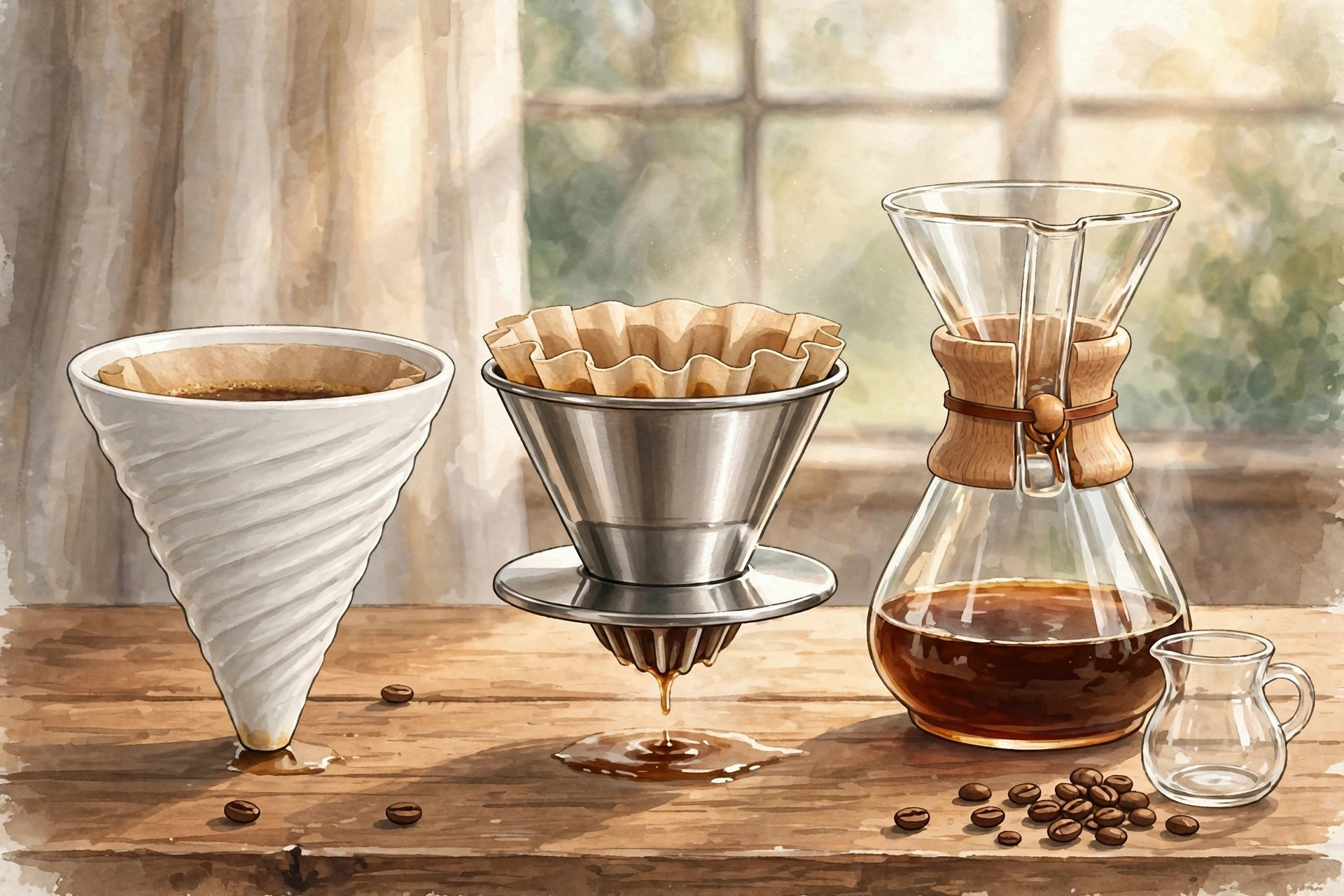
V60 vs Chemex vs Kalita Wave is the right version of that question, because the three drippers are genuinely different machines, not three brands of the same thing. They differ in geometry, in what the filter does, in how much your pouring hand matters, and in how many cups they are built for. All three cost under $50 for the brewer itself. The money is not the decision. Your mornings are.
/ 01Three shapes, three ideas about extraction
Start with what each one is doing to the water, because everything else follows from that.
The Hario V60 is a 60-degree cone with spiral ribs and one large hole at the bottom. Nothing restricts the flow except your pour and your grind. Pour fast and the water runs through fast; pour slow and it lingers. Hario launched the V60 in 2005, and the design has barely changed since, which is either a sign that it was right the first time or that pour-over people are conservative. Both can be true. The 02 size covers one to four cups, takes ordinary V60 02 papers, and in plastic it costs about $13 — $11.94 on Amazon at a price check on November 13, 2026, $13 to $14 on Hario USA’s own store. The ceramic version is around $27 to $30.50. Prices move, so treat every number here as a reference price checked this week, not a quote that will hold.
The Kalita Wave is the opposite bet. Flat bottom, a bed of coffee that sits level instead of tapering to a point, and three small holes that limit how fast water can leave. The wave-shaped filter touches the dripper at very few points, which Kalita says keeps water from pooling and makes extraction more even. The practical effect is that your pour matters less. A sloppy pour on a V60 shows up in the cup; a sloppy pour on a Wave mostly does not. The stainless 185, the size most people buy, is listed at $42 on Kalita USA’s store and was around $34 to $39 on Amazon this week, for two to four cups. Wave 185 filters run about $13 for a hundred, and they are proprietary — no other paper fits properly.
The Chemex is not really a dripper in the same sense. It is a brewer and a carafe in one piece of borosilicate glass, invented in 1941 by the chemist Peter Schlumbohm, and it has been sitting in the Museum of Modern Art’s permanent collection longer than most of us have been alive. Its trick is the filter: a thick bonded paper, far heavier than a V60 or Wave paper, that strips out oils and fine sediment. The cup that comes out is strikingly clean and bright, sometimes to a fault — the same filter that removes bitterness also removes some of the body that makes a coffee feel rich. The Six Cup Classic is $49.50 from Chemex itself and $47.03 on Amazon this week. Chemex counts a cup as five ounces, so six cups is about 30 ounces: this is a brewer for two or three people, or for one person who drinks a lot.
/ 02The V60: the most control, and the least forgiveness
The V60 is the dripper for someone who wants to learn, and that is not a euphemism. Its open design means the full range of technique is available to you — grind finer and pour slower for more extraction, grind coarser and pour faster for less — and it also means the full range of mistakes is available. An inconsistent grind is the classic V60 failure: boulders and dust in the same bed, one under-extracting while the other over-extracts, and no amount of pouring practice fixes it. The dripper is twelve dollars. The grinder is the purchase that decides whether the V60 is brilliant or frustrating, which is why the same advice appears in nearly every beginner thread: the brewer is the cheap part.
What the V60 gives back for that honesty is the brightest, most articulate cup of the three, and the widest library of recipes. James Hoffmann’s ultimate V60 technique, the 4:6 method, the single-pour Mugen variant — all of it is written for this cone. If you brew at a desk and you treat the morning cup the way you treat a build — a system with variables you can tune — the V60 is the dripper that rewards that instinct. Plastic holds heat better than ceramic and will not crack when it slides off the desk; ceramic looks better on a shelf and costs twice as much for the same geometry. Buy the plastic one first. If you ever want the ceramic one, you will know exactly why.
/ 03The Kalita Wave: the one that behaves on a bad morning
The Wave exists for the mornings when you do not have the attention to spare. Its flat bed and restricted drain holes set a floor under the extraction: water cannot rush through just because your hand wobbled, and the level bed means the grounds extract more evenly than in a cone, where the bottom of the bed always works harder than the top. The cup tends toward sweetness and body rather than the V60’s brightness — less sparkle, more roundness, and a lot more consistency from one day to the next.
That consistency is the whole argument, and it is a good one for a developer’s desk. A Wave with a decent grinder and a scale will make a good cup on a morning when you are half asleep and thinking about a failing test suite, which is exactly when the V60 will punish you. The trade-offs are real but small: the filters cost more than V60 papers and are harder to find in a random supermarket, the stainless version has a known quirk where a wet filter can suction against the drain holes and stall the draw, and the ceiling is lower — a great V60 cup can be more expressive than a great Wave cup. But the floor is much higher, and floors matter more than ceilings before the first standup.
/ 04The Chemex: the cleanest cup, and a brewer for more than one
The Chemex is the odd one out in this comparison, and it is worth saying so plainly. Nobody buys a Chemex because it is the best way to make one mug for one person. You buy it because it makes a pot of strikingly clean coffee for several people, and because it looks like it belongs in a design museum — it literally does. The thick bonded filters are the whole story: they remove more oil and sediment than any other paper in this comparison, and the result is a cup where individual flavours stand apart with unusual clarity. Light roasts in particular come through with a brightness that can feel almost tea-like.
The costs are the filter and the batch size. Chemex filters are the most expensive of the three and there is no substitute — only Chemex bonded papers fit properly. And the brewer is happiest making 30 ounces. Brewing a single 12-ounce mug in a six-cup Chemex works, but the bed is shallow, the drawdown is fast, and you are using the wrong tool for the job. If you regularly brew for a household, a pair-programming session, or a weekend table, the Chemex earns its place. As a first and only pour-over for one person, it is the wrong pick, and the beginner guides that say so are right.
/ 05The numbers side by side
| Dripper | Shape | Capacity | Brewer price (ref., Nov 13, 2026) | Filter |
|---|---|---|---|---|
| Hario V60 02, plastic | 60° cone, one large hole | 1–4 cups | ~$12–14 | V60 02 papers, cheap and everywhere |
| Kalita Wave 185, stainless | Flat bottom, three small holes | 2–4 cups | ~$34–42 | Wave 185 papers, ~$13/100 |
| Chemex Classic, 6-cup | Cone + carafe, one piece | 6 cups (~30 oz) | ~$47–50 | Chemex bonded papers, priciest of the three |
All prices are reference prices checked the week of November 13, 2026, from maker stores and Amazon listings. They change, often during sales, so check the current price before buying. HexRoast runs no affiliate links and takes no commission on any of these; the prices are here so you can judge the decision, not so you can click through.
/ 06The question that actually decides it
Three questions sort this out faster than any ranking, and they have nothing to do with brand loyalty.
First, how many cups, and for how many people? One mug for yourself points at the V60 or the Wave. A pot for a household points at the Chemex, and nothing else in this comparison does that job.
Second, how much of the process do you want to own? If tuning variables sounds like a good morning, the V60’s open design is a feature. If tuning variables sounds like work you do not have time for before standup, the Wave’s restricted flow is the feature. This is the same split that runs through the r/pourover threads: one camp recommends the V60 because its skill ceiling teaches you, the other recommends the Wave or the Switch because a forgiving brewer gets you a good cup while you are still learning everything else.
Third, what is already the weak link in your setup? If your coffee tastes flat, the answer is almost certainly the grinder, not the dripper. Buying a new brewer to solve a grinder problem is the most common expensive mistake in home coffee, and it is worth repeating here because all three of these drippers are cheap enough to buy on impulse. A V60 with a good grinder beats a Chemex with pre-ground supermarket coffee every single time. Our grind-size guide covers that in more detail; the short version is that particle size sets the pace of extraction, and no dripper geometry can rescue a grind that is half boulders and half dust.
/ 07What I would buy
If I were starting from nothing tomorrow, with a desk, a kettle and a grinder already sorted, I would buy the plastic V60 02 for about $13 and a hundred papers, and spend the money I saved on better beans. It is the cheapest genuinely good cup in coffee, it has the deepest bench of recipes to learn from, and it is the only one of the three that teaches you something about brewing while you use it. The honest caveat is that the first month will include some bad cups, and that is the price of the education.
If my mornings were the rushed kind — and most developer mornings are — I would buy the Kalita Wave 185 instead and not look back. The difference between a good Wave cup and a good V60 cup is real but small; the difference between a bad Wave cup and a bad V60 cup is large, and it runs in the Wave’s favour. Consistency is a feature, not a compromise.
And if I were buying for a kitchen where two or three people drink coffee together, I would buy the Chemex and accept the filter cost as the price of the cleanest pot in this comparison. It is the only one of the three that is really a serving vessel, and it is the only one you will still be glad to look at in ten years.
The three drippers have been the default answer to “which pour-over should I buy” for a decade, and the reason they are still the answer is that they are three different answers. The V60 is control. The Wave is consistency. The Chemex is clarity at scale. Pick the one that matches the mornings you actually have, not the mornings you wish you had.
/ 08Sources
- jayarr.coffee, pour-over comparison — specs and prices checked October 18, 2026
- The Espresso Report, best pour-over under $50 — prices checked November 13, 2026
- Hario UK, gift guide 2026 (updated November 11, 2026) — V60 launched 2005
- BeanBook, analysis of r/pourover filter and beginner threads (published November 4, 2026)
- Onyx Coffee Lab, “Picking a coffee brewer with Rafa” (Instagram, November 12, 2026)
- Tamp & Pour, best pour-over coffee makers 2026 (prices as of November 12, 2026)
- Note: Prices are reference prices that change; no affiliate links and no purchase links are included in this article.
---
HexRoast is a coffee journal. No product is for sale and no preorder is open. Prices above are reference prices as listed on November 13, 2026, and change — re-check before repeating them. Contact: hello@hexroast.com.
Questions about this article: hello@hexroast.com — the one contact address for this site. HexRoast is currently a coffee journal; no product is for sale and no preorder is open.
More coffee writing in this section — no signup, no preorder, just the journal.
More in Brew →