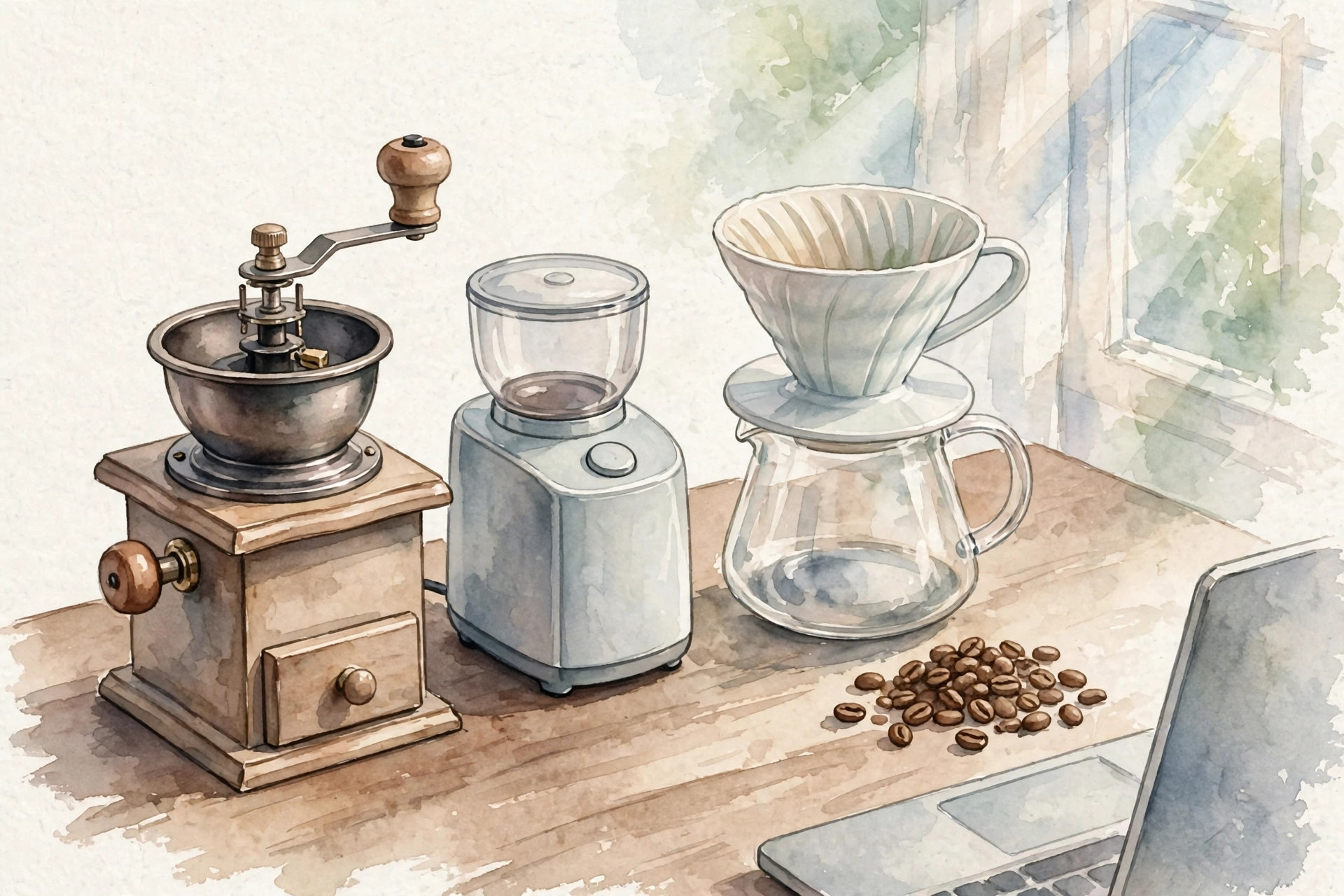
On 11 November, a small company called Nexra put a motor on Kickstarter that bolts onto the Comandante C40 — the hand grinder a lot of coffee people treat as the default good one — and turns it electric. It runs at 60rpm, which Nexra calls "hand-grinding pace," charges over USB-C, reverses itself if it jams, and costs $159 for early backers against a $199 retail price. The campaign funded more than twenty times over in days. A Facebook post from Gadget Audit on 13 November showing a C40 with an electric module attached is part of the same conversation, which is the part that matters: people are not arguing about whether the motor works. They are arguing about whether the question it answers — hand grinder vs electric grinder — was ever the right question.
It was, and it still is, but the answer has shifted. A hand grinder vs electric grinder comparison used to be a clean split: your arm or your wallet. This month the split got messy in useful ways, because the grinder market moved at every tier at once. Wilfa, the Norwegian company behind the brewer Tim Wendelboe helped design, launched US operations in early November with a redesigned Uniform EVO grinder at $399. Weber Workshops rebuilt its flagship EG-1 from the inside, starting at $4,450. And down where most of us actually shop, the $100 and $200 tiers now have clear, checkable answers — different answers at each price, which is the whole point of this comparison.
One note before the prices: this is about standalone grinders. If your espresso machine has a grinder built in, that is a different decision, and the machines themselves are a separate comparison. Everything below assumes you already have a brewer — a V60, an AeroPress, a French press, a home espresso machine — and you are deciding what feeds it.
/ 01Why the grinder is the upgrade, not the brewer
We have said this before in our piece on grind size, and it bears repeating because it decides the whole budget: grind consistency is the bottleneck in most home setups. A good brewer cannot fix uneven grounds. A $30 dripper with a consistent grind will out-brew a $300 machine fed with dust and boulders, because the fine particles over-extract and the coarse ones under-extract in the same cup, and no ratio tweak rescues that. So when the budget is $100 or $200, the grinder is where the money goes first. The question is only which kind.
/ 02At $100, the hand grinder wins — and it is not close
Spend $100 on an electric grinder and you get a motor attached to a compromise: small burrs, sloppy adjustment, a hopper that holds more beans than you will use before they go stale. Spend $100 on a hand grinder and you get the opposite — no motor, and burrs that would cost twice as much in an electric body.
The Timemore Chestnut C3 is the entry point, selling for around $70 to $90 depending on the variant and the retailer. It has 38 mm stainless steel conical burrs, an aluminium body, and a folding handle, and it is honest about what it cannot do: the standard C3 is a filter grinder. It will not grind fine enough for espresso, and the company does not pretend otherwise. For pour-over, AeroPress, and French press, it is the cheapest way to get a genuinely even grind, and it has been the default recommendation at this price for years because nothing electric near it is as consistent.
The step up inside the same tier is the 1Zpresso Q2, around $80 to $99, or the 1Zpresso JX at $100 to $120. The JX moves to 48 mm steel burrs, grinds faster, and handles a full dose without the wrist workout the smaller grinders demand. If espresso is on your mind, the Timemore C3 ESP — a variant of the C3 with finer clicks, about 23 microns per step against the standard C3's 83 — sells for around $99 and is the cheapest credible route to dialling in a shot by hand. That is the shape of the $100 tier: for the price of one mid-range electric, you can buy a hand grinder that grinds better than electrics costing twice as much.
What you pay instead of money is effort and time. A hand grinder is single-dose by design: you weigh the beans, you pour them in, you crank. One cup takes a minute or so of steady turning, and light roasts — the dense, hard beans specialty roasters favour — take noticeably more of it. Two cups back to back is a small workout. Three, for guests, is a reason to own an electric. Hand grinders are also quiet, which matters more than people admit: at 6 a.m., a hand grinder is the difference between coffee and waking the household. It fits in a desk drawer, it travels in a bag, and it has no motor to burn out. The trade is simple and it is real. You are the motor.
/ 03At $200, the electric grinder becomes a real choice
Double the budget and the electric side of the comparison stops apologising. The two grinders that define the $200 tier are the Baratza Encore ESP at $199.95 and the Fellow Opus at around $195, with the newer Opus 2 also at $199.95. Both are conical burr electrics that cover filter and espresso from one machine, which is the thing the $100 electrics cannot do.
The Encore ESP is the proven buy. It has 40 mm conical steel burrs and 40 grind settings, with the first twenty steps in a fine, high-resolution espresso range — each click in that range moves the burrs about 20 microns, small enough to dial in a shot without overshooting. It has a hopper, a timed grind, and the thing that actually matters over five years of ownership: Baratza sells every replacement part, and there are repair guides for all of it. It is not beautiful and it is not quiet, but it is the grinder most people in this price range end up keeping.
The Fellow Opus 2 is the paper champion. Same $199.95, but with larger 48 mm conical burrs, a stepless dial instead of stepped clicks, and a single-dose design that suits people who weigh each dose. On paper it beats the Encore ESP. In practice, nobody knows yet: it only started shipping in October 2026, and the first Opus disappointed owners on exactly the static and retention the Opus 2 claims to fix. Until owners report back over a few months, the Encore ESP is the safer $200.
There is a third option at this tier that people miss because it is not electric: the hand grinder gets better, too. The 1Zpresso JX-Pro, around $159, and the 1Zpresso J-Ultra, around $170 to $200, are hand grinders with the fine external adjustment espresso demands — the JX-Pro has more than 200 clicks across its range — and grind quality that reviewers keep comparing to electrics at twice the price. And if you only brew filter coffee and never plan to pull a shot, the plain Baratza Encore at around $150 is still the default electric for pour-over and drip, and the $50 you save is a bag of good beans.
So at $200 the comparison finally becomes a real choice instead of a rout. The hand grinder gives you better burrs per dollar and silence. The electric gives you speed, a hopper, and the ability to make coffee for more than one person without thinking about your forearm.
/ 04The motor that bolts on: what the Nexra NM1 actually changes
Back to the news that opened this piece, because the Nexra NM1 is interesting precisely for what it does not do. It does not make hand grinding cheap. It only fits the Comandante C40, and the C40 itself lists at €259 in Europe and typically sells for around $300 in the US. Add the Nexra at $159 on Kickstarter or $199 at retail, plus $65 for the optional stand and magnetic dosing cup, and the full package lands near $224 before you count the grinder it attaches to — over $460 all in. What it does is let someone who already owns a C40, and already loves how it grinds, stop cranking. It is an upgrade path for an existing purchase, not a shortcut for a new one. And it is a Kickstarter project, not a retail product: its campaign ran in mid-November, and the team said rewards were ready to ship as early as December. Crowdfunded hardware ships late often enough that the delivery date belongs in the fine print, not the headline.
The honest read is that the NM1 proves the two categories are converging, not that one of them won. A motor at hand-grinding speed is an admission that the hand grinder had something worth preserving — low RPM, low heat, low fines — and the electric grinder had something worth adding, which is not having to crank at 6 a.m. The $200 electrics are moving the same direction from the other side: the Opus 2's single-dose design is an electric grinder borrowing the hand grinder's ritual of weighing each dose. The categories are meeting in the middle, and the buyer benefits either way.
/ 05How to decide, by how you actually brew
Forget the spec sheets for a moment and count cups. One cup a day, usually pour-over, usually alone, and you like the ritual: buy the hand grinder. The C3 at around $80 or the JX at around $110 will grind better than anything electric near the price, and the minute of cranking is part of the morning, not a tax on it. Two cups every morning, or espresso most days, or a household where more than one person drinks coffee: buy the electric. The Encore ESP at $199.95 is the pick until the Opus 2 earns its record, and the plain Encore at around $150 covers you if espresso never enters the picture. Travel a lot, or brew at a desk where a motor would be rude: hand grinder, no contest — it is the size of a water bottle and silent. Already own a C40 and want your mornings back: the Nexra is your upgrade, and it is the only scenario where it makes financial sense.
There is a developer's way of framing this, and we will use it once: a hand grinder is a sharp single-purpose tool, and an electric grinder is a service that runs in the background. You reach for the tool when you care about the process and you run the service when you care about the output. Most of us need one or the other, and the mistake is buying the service before you know which kind of brewer you are.
/ 06What to skip
Blade grinders, at any price, because they chop instead of grinding and no technique fixes that. Electric grinders under $100 that list espresso among fifteen settings — they cannot grind fine enough or evenly enough, and the $60 you save is a bag of beans ground badly for a year. And do not jump to the $400 tier before you know your brew method: the Wilfa Uniform EVO at $399 and the Weber EG-1 at $4,450 are real products for people with settled habits, not answers to a question you have not asked yet. A grinder is the one piece of coffee gear where spending more only helps after you know what you are grinding for.
/ 07The bottom line
| Budget | Hand grinder pick | Electric grinder pick |
|---|---|---|
| Around $100 | Timemore C3 (~$70–90) for filter; C3 ESP (~$99) or 1Zpresso JX (~$100–120) if espresso matters | Nothing we would recommend — the electrics at this price give up too much |
| Around $200 | 1Zpresso JX-Pro (~$159) or J-Ultra (~$170–200) for the best grind per dollar | Baratza Encore ESP ($199.95) for proven espresso + filter; plain Encore (~$150) for filter only |
At $100, the hand grinder wins on grind quality and loses on effort. At $200, the electric catches up on quality and wins on convenience, and the hand grinder answers by getting good enough for espresso. The Nexra NM1, Wilfa's US launch, and the rebuilt EG-1 all point the same way: the grinder market is moving fast, and the line between hand and electric is thinner than it was a month ago. But the decision has not changed. Count your cups, know your brew method, and buy the grinder that fits the morning you actually have — not the one you imagine having.
Prices are reference prices checked on 17 November 2026 from manufacturer listings and retailer guides; they change often, especially around Black Friday and the holidays, so check the current price before you buy. HexRoast has no affiliate links and no sponsored placements — nothing here earns us a commission.
/ 08Sources
- The Nova Cafe, "Nexra NM1 electric attachment for Comandante C40 launches on Kickstarter," 11 November 2026 — $159 Kickstarter / $199 MSRP, 60rpm, USB-C, auto-reverse, 20x funded, shipping as early as December. https://thenovacafe.com/news/nexra-nm1-electric-attachment-for-comandante-c40-launches-on-kickstarter/
- The Nova Cafe, "Wilfa launches US operations with new coffee machines and grinder," 2 November 2026 — Uniform EVO $399, 64 mm flat burrs, Williams Sonoma and specialty retailers. https://thenovacafe.com/news/wilfa-launches-us-operations-with-new-coffee-machines-and-grinder/
- Daily Coffee News via Poleharmony, "Weber Workshops Launches Thoroughly Redesigned EG-1 Grinder" — from $4,450, 22% more torque, Vibe Tone purge, shipments in the coming weeks. https://eating.poleharmony.com/article/284
- First Pull Coffee, "Best Espresso Grinder Under $200," October 2026 — Encore ESP $199.95, Opus $195, 40 mm conical burrs, 40 settings. https://www.firstpull.coffee/guides/best-espresso-grinder-under-200/
- Supply Coffee, "Baratza Encore ESP vs Fellow Opus 2" — both $199.95 base prices checked 21 September 2026. https://www.supply.coffee/guides/baratza-encore-esp-vs-fellow-opus-2
- Barista Bench, "Best Espresso Grinder for Home" — Opus 2 started shipping October 2026 at $199.95; first Opus fell short on static and retention; Encore ESP the proven buy. https://baristabench.com/best/best-coffee-grinder-for-home
- CripsyWire, "Best Home Coffee Grinders 2026" (updated 1 November 2026) — Encore ~$150, Encore ESP ~$199, Opus ~$195. https://cripsywire.com/best-home-coffee-grinders/
- Brewed Barista, "The Best Hand Grinders for Every Budget (2026)" — Timemore C3 $40–50 (C3S ~$80), 1Zpresso Q2 $80–90, 1Zpresso JX $100–120, J-Ultra $170–200. https://www.brewedbarista.com/guides/best-hand-grinders-every-budget-2026
- CoffeeBle, "1Zpresso JX-Pro Review" — $159. https://coffeeble.com/reviews/1zpresso-jx-pro/
- Coffee Corners, "1Zpresso K-Ultra vs Comandante C40" — C40 listed at €259 (maker price), German retail €199–249, checked 1 November 2026. http://coffee-corners.com/blog/1zpresso-k-ultra-vs-comandante-c40-mk4
- Balance Journal, "Timemore Chestnut C3 Review" — C3 ESP 23 microns per click vs standard C3's 83; C3 not espresso-capable, C3 ESP is. https://www.balancejournal.co/food-drink/timemore-chestnut-c3-review
- Facebook, Gadget Audit, 13 November 2026 — Comandante manual grinder with electric module, ongoing discussion. https://www.facebook.com/GadgetAudit/posts/pfbid0ZHqixfa9e6LLtRNqyYjhe9ViyXfqL6sB1dbvDrRrEwQ7puQPghPVWz2hSoJU9w5Fl
- Note: Prices are reference prices that change; no affiliate links and no purchase links are included in this article.
---
HexRoast is a coffee journal. No product is for sale and no preorder is open. Prices above are reference prices as listed on November 17, 2026, and change — re-check before repeating them. Contact: hello@hexroast.com.
Questions about this article: hello@hexroast.com — the one contact address for this site. HexRoast is currently a coffee journal; no product is for sale and no preorder is open.
More coffee writing in this section — no signup, no preorder, just the journal.
More in Brew →